





Government outlines BDT 60,000 crore industrial recovery package as private sector demands corporate tax cuts and policy stability.
Dhaka | June 7, 2026
The Government of Bangladesh is developing a comprehensive “New Economic Model” designed to navigate ongoing macroeconomic challenges and elevate the country into a $1 trillion economy by 2034, according to Rashed Al Mahmud Titumir, the Finance and Planning Advisor to the Prime Minister’s Office (PMO).
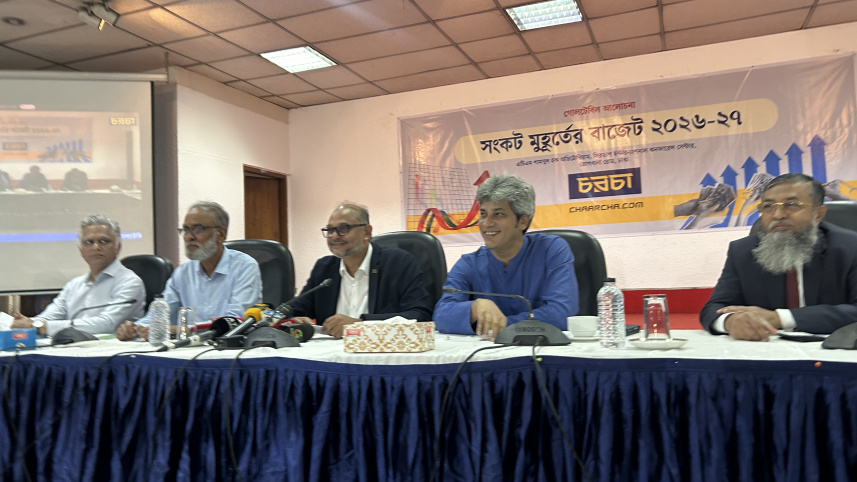
Speaking as the chief guest at a roundtable discussion titled “Budget for the Crisis Moment 2026-27” on Saturday, Advisor Titumir stated that the administration’s core governing philosophy is “Bangladesh for All.” This approach aims to ensure that the dividends of macroeconomic growth are equitably distributed across all social strata. The high-level economic forum, held at the CIRDAP International Conference Center in the capital, was organized by the digital platform Charcha.com and attended by State Minister for Planning Jonaed Saki as a special guest.
To catalyze private investment, Titumir emphasized that the government is actively prioritizing administrative overhauls, dismantling bureaucratic red tape, and establishing a level playing field for both domestic and export-oriented industries. As a direct intervention to revive stalled manufacturing capabilities, he revealed that the government is finalizing a BDT 60,000 crore industrial restructuring package to breathe life back into closed factories. The advisor also highlighted the critical need for long-term structural changes in water resource management to protect agriculture, alongside improving the efficiency of public spending in healthcare, education, and grassroots service delivery.
The roundtable featured strong policy appeals from the private sector. Nasim Manjur, Managing Director of Apex Footwear, argued that sweeping structural reforms to the national tax architecture are vital to stimulate private enterprise and attract Foreign Direct Investment (FDI). Manjur proposed slashing the current corporate tax rate from 27.5% down to 20%, citing Vietnam’s competitive fiscal model as a benchmark. He stressed that policy unpredictability and administrative friction remain the most severe deterrents for investors, urging the government to guarantee a stable tax framework for at least three consecutive years.
Furthermore, Manjur criticized chronic logistical bottlenecks, pointing out that subpar warehouse and cold-storage management at international airports costs the country hundreds of millions of dollars annually in damaged raw materials. He strongly advocated for the immediate digitization of tax administration and the introduction of a risk-based auditing system. Addressing structural weaknesses in social infrastructure, Manjur noted that citizens still bear 74% of total medical expenses out-of-pocket, calling it an unsustainable burden for a developing economy that requires immediate infusion of targeted foreign healthcare investments.
Shifting the focus to rural equity, prominent researcher and activist Maha Mirza pointed out that despite serving as the ultimate buffer for food security and the rural economy, the agricultural sector has historically been underfunded. She strongly recommended doubling the national budgetary allocation for agriculture from the current 5% to 10%. Mirza stressed that relying on traditional sun-drying methods for paddy in 2026 underscores an urgent mechanization gap, demanding that affordable post-harvest equipment, crop dryers, and combine harvesters be delivered directly to smallholders.
Mirza also raised concerns regarding governance, alleging that state-backed agricultural incentives and mechanization privileges frequently get diverted to politically influential individuals rather than genuine farmers. Due to a lack of off-season investment in the rural economy, she noted that a massive segment of agricultural laborers remains structurally unemployed for significant parts of the year, driving forced migration to overpopulated urban centers. To counter this, she urged the expansion of union-level state procurement hubs, state sifting warehouses, and dedicated cold-chain grids for perishable dairy and produce.
The broader panel of economists and industry leaders concluded that given the prevailing pressures of high inflation, investment stagnation, and employment deficits, the upcoming budget must be deeply grounded in structural reality and reform. They collectively urged the government to prioritize the modernization of revenue collection, transparency in financial governance, and reliable, long-term policy predictability.
The event featured insights from other notable experts, including Dr. M. Masrur Reaz, Chairman of Policy Exchange Bangladesh; Muslim Chowdhury, former Finance Secretary; Mohammad Hatem, President of the Bangladesh Knitwear Manufacturers and Exporters Association (BKMEA); Kausar Alam, President of the Institute of Cost and Management Accountants of Bangladesh (ICMAB); and Dr. A.K.M. Waresul Karim, Dean of the School of Business and Economics at North South University. The policy session was moderated by Charcha Editor Sohrab Hassan.
📊 Key Macroeconomic Indicators & Proposed Reforms
| Policy Metric | Current Framework | Proposed / Target Level |
| National GDP Value | ~$450 Billion | $1 Trillion (Target by 2034) |
| Industrial Stimulus Package | Baseline Operational | BDT 60,000 Crore (Factory Revival) |
| Corporate Tax Rate | 27.5% | 20.0% (To match Vietnam) |
| Agricultural Budget Share | 5.0% of total budget | 10.0% of total budget |
| Out-of-Pocket Healthcare Costs | 74.0% of total medical bills | Significant reduction via FDI |
| Policy Guarantee Window | Variable / Annual Changes | 3-Year Absolute Stability |
💬 Statements from Key Stakeholders
“The government’s philosophy is ‘Bangladesh for All,’ ensuring that the macroeconomic fruits of growth reach every single tier of our society. We are focused on administrative reforms and breaking down bureaucratic complexities.”
— Rashed Al Mahmud Titumir, PMO Finance and Planning Advisor
“Investors are suffering the most due to sudden policy shifts and administrative bottlenecks. It is absolutely essential to ensure a stable tax policy for at least three years and reduce corporate tax to 20% if we wish to remain globally competitive.”
— Nasim Manjur, Managing Director, Apex Footwear
“Even in 2026, our farmers are forced to rely purely on the sun to dry their crop, which is entirely incompatible with modern agricultural demands. We must deliver affordable crop dryers and combine harvesters to their doorsteps.”
— Maha Mirza, Researcher and Activist
Sources
- Official Transcript and Proceedings of the “Budget for the Crisis Moment 2026-27” Roundtable, CIRDAP International Conference Center (June 6, 2026).
- Policy Declarations, Office of the Finance and Planning Advisor to the Prime Minister of Bangladesh.
- Charcha.com Editorial Briefings and Stakeholder Records.